
Saturday, 21 March 2015

Friday, 20 March 2015

Thursday, 19 March 2015

Wednesday, 18 March 2015

Tuesday, 17 March 2015

Monday, 16 March 2015

Sunday, 15 March 2015

Saturday, 14 March 2015

Friday, 13 March 2015

Thursday, 12 March 2015

Wednesday, 11 March 2015

Tuesday, 10 March 2015

Monday, 9 March 2015

Sunday, 8 March 2015
Octant History, San Diego Maritime Museum

"In the year 1700, Isaac Newton conceived the idea of measuring the altitude of a colonial body by bringing an image to the horizon by the use of mirrors. Thirty years later, John Halley in England and Thomas Godfrey in America independently invented octants using this principle."
Saturday, 7 March 2015

Friday, 6 March 2015

Thursday, 5 March 2015

Wednesday, 4 March 2015

Changing LaTeX Margins
\usepackage[
top = 2.75cm,
bottom = 2.50cm,
left = 3.00cm,
right = 2.50cm]{geometry}
top = 2.75cm,
bottom = 2.50cm,
left = 3.00cm,
right = 2.50cm]{geometry}
source: http://www.latex-community.org/forum/viewtopic.php?f=47&t=9531&p=36543
Tuesday, 3 March 2015

LaTeX: Scale Image to Page Width
\includegraphics[width=\columnwidth]{path-to-file}
\textwidth also works for single columns.
\textwidth also works for single columns.
source: http://tex.stackexchange.com/questions/39147/scale-image-to-page-width
Monday, 2 March 2015
Sunrise+Sunset Observation
Recently, the days have been getting longer. Sunrise comes earlier and sunset occurs later. Looking at the recent [rapid noticeable] elongation of the day in March, and how the temperature is rising rapidly, we can guess that we sit on the smaller-sector side of our orbital ellipse.
From Kepler's second law, "A line segment joining a planet and the Sun sweeps out equal areas during equal intervals of time."
Verifying on a seasonal orbit diagram for March, we are indeed closer to the periapsis than the apoapsis.

From Kepler's second law, "A line segment joining a planet and the Sun sweeps out equal areas during equal intervals of time."
Verifying on a seasonal orbit diagram for March, we are indeed closer to the periapsis than the apoapsis.
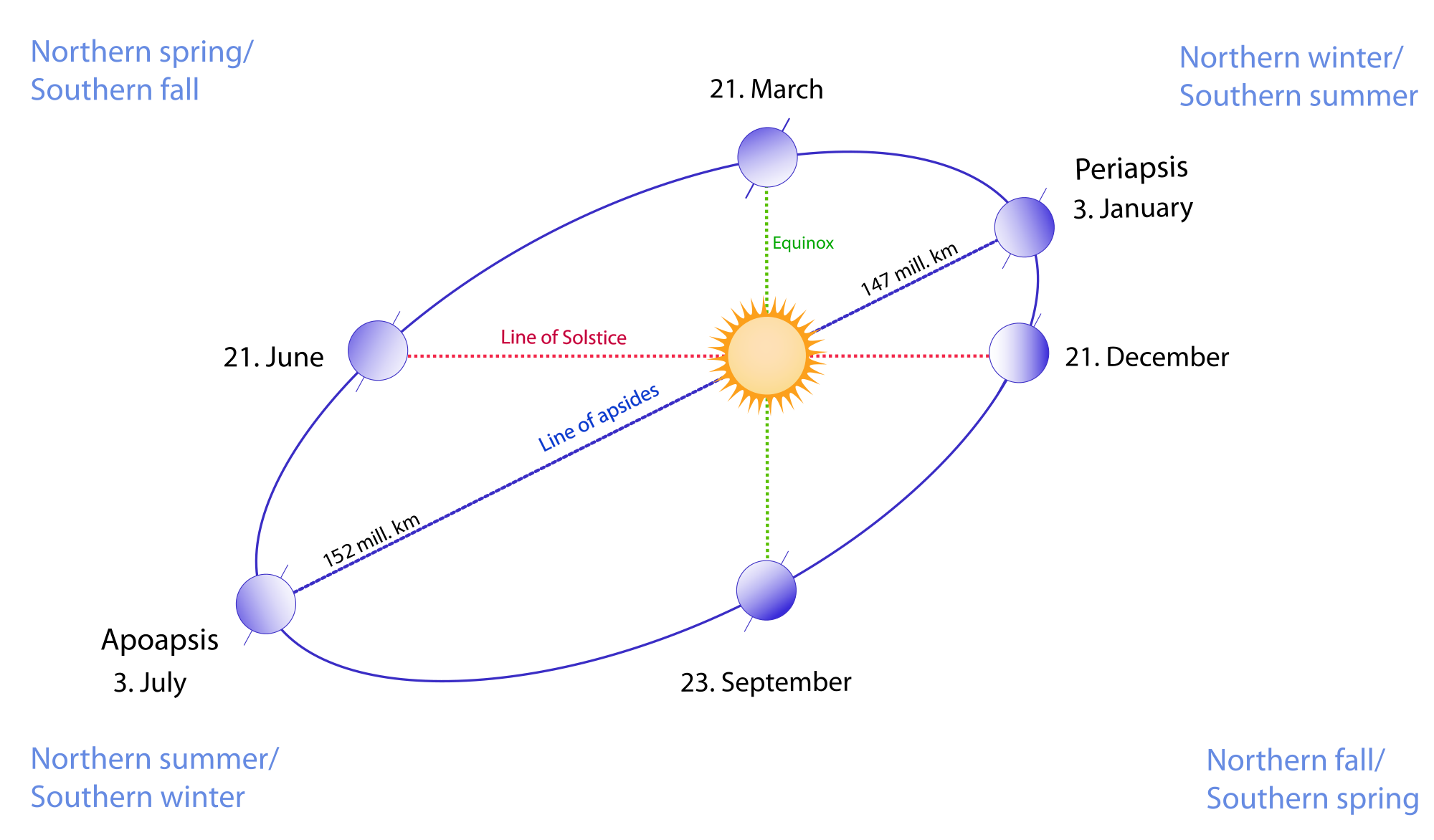
Working backwards from experimental data may have resulted in deducing an elliptical orbit, eventually leading to how these laws were established.
source: http://upload.wikimedia.org/wikipedia/commons/thumb/f/f0/Seasons1.svg/2000px-Seasons1.svg.png
http://en.wikipedia.org/wiki/Kepler%27s_laws_of_planetary_motion
Saturday, 28 February 2015
Colors in LaTeX
Default: red, green, blue, cyan, magenta, yellow, black. Green, yellow are really bright. Magenta can sometimes be hard to distinguish from black. Alternatively, can specify the colorspace and values. Other options are available with the dvipsnames option.
source: https://www.sharelatex.com/learn/Using_colours_in_LaTeX
source: https://www.sharelatex.com/learn/Using_colours_in_LaTeX
Friday, 27 February 2015
Widening Gaps in Living Standards
"Today 99 percent of Americans living below the poverty line have electricity, water, flushing toilets, and a refrigerator; 95 percent have a television; 88 percent have a telephone; 71 percent have a car; and 70 percent even have air-conditioning. This may not seem like much, but one hundred years ago men like Henry Ford and Cornelius Vanderbilt were among the richest on the planet, but they enjoyed few of these luxuries."
-Abundance: The Future Is Better Than You Think, Peter Diamandis
-Abundance: The Future Is Better Than You Think, Peter Diamandis
Ordering Citations in LaTeX by Appearance
Change
\bibliographystyle{plain}
to
\bibliographystyle{ieeetr}
Then rebuild it a few times to replace the
.aux and .bbl files that were made when you used the plain style.
If you use MiKTeX you shouldn't need to download anything extra.
Note: 'plain' style uses alphabetical order.
source: http://stackoverflow.com/questions/144639/how-do-i-order-citations-by-appearance-using-bibtex
Subscribe to:
Posts (Atom)